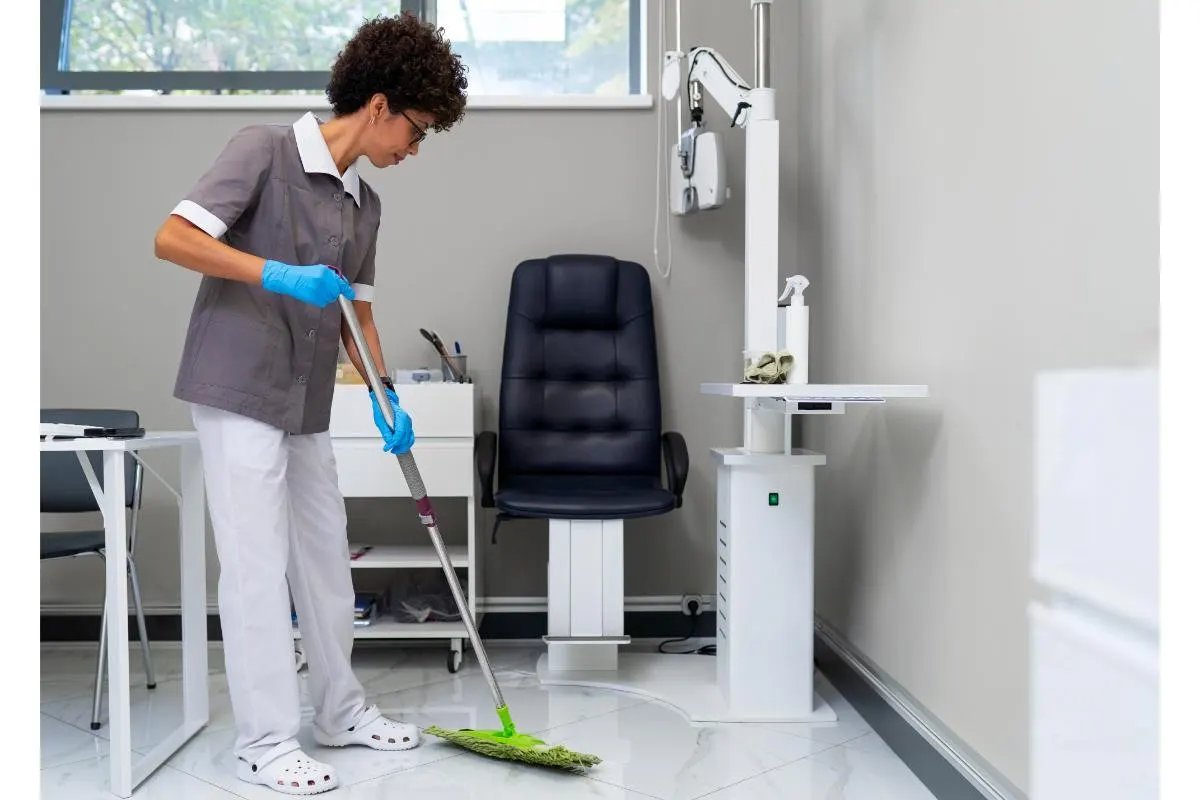
A CQC inspection looks beyond whether your premises are visibly clean. It looks for documented evidence of a consistent, controlled cleaning programme. CQC Regulation 12 requires registered healthcare providers to maintain documented evidence of infection prevention and control — and most practice managers discover the gap when it is too late.
What CQC actually inspects when it comes to cleaning
The Care Quality Commission regulates health and social care providers in England against a set of fundamental standards. Regulation 12 — Safe care and treatment — is the regulation that specifically covers infection prevention and control. Under Regulation 12, registered providers must assess the risk of, and prevent, detect, and control the spread of infections. Inadequate infection prevention arrangements are a Regulation 12 breach, which can result in a requirement notice, warning notice, or in serious cases, enforcement action.
Critically, CQC does not simply inspect whether your premises look clean. It inspects whether your infection prevention and control (IPC) arrangements are documented, systematic, and consistently applied. A premises that looks clean but has no documented cleaning schedule, no operative training records, and no visit logs is still a Regulation 12 risk — because the evidence of consistent control is absent.
The CQC guidance on Regulation 12 specifically states that providers must ensure equipment is clean and hygienic, that premises reduce the risk of infection, and that staff are appropriately trained in infection prevention. CQC inspectors typically review: your IPC policy, your cleaning schedule and specification, completion records, staff training records, and any audit or monitoring activity.
If you cannot produce these documents during an inspection — or if your cleaning contractor cannot provide them — you have a gap that needs to be closed immediately.
The NHS National Standards of Cleanliness — and why they matter to GP practices
NHS England's National Standards of Cleanliness — the NuSpec (National Uniform Cleaning Standard) framework — sets out cleanliness standards, risk classifications, and audit methodologies for NHS healthcare premises. While GP surgeries and independent dental practices are not NHS acute trusts and are not legally obligated to implement NuSpec directly, CQC inspectors trained in NHS environments routinely reference NuSpec as the benchmark for what "good" looks like in healthcare cleaning.
The NuSpec framework classifies functional areas by risk:
- Very high risk: Theatres, sterile services, critical care — not typically present in GP surgeries
- High risk: Outpatient departments, treatment areas, consulting rooms — these apply directly to GP and dental settings
- Significant risk: Waiting areas, reception, corridors with patient contact
- Low risk: Offices, car parks, external areas
Each risk level has an associated minimum cleaning frequency. For a GP surgery, the consulting rooms (high risk) should be cleaned at minimum daily — and ideally after each session if patient throughput is high. Waiting areas (significant risk) should also be cleaned daily, with additional attention to high-touch surfaces (door handles, seating, card terminals) during the day.
A cleaning contractor working in your premises should be able to demonstrate which NuSpec risk category each area of your premises falls into, and confirm that their cleaning frequency and methodology aligns with the standard.
COSHH in healthcare cleaning — what it requires
The Control of Substances Hazardous to Health Regulations 2002 (COSHH) require employers to assess the risks from hazardous substances used at work and take adequate control measures. In healthcare cleaning, every cleaning product — disinfectants, sanitisers, degreasers, toilet cleaners — is a hazardous substance for COSHH purposes.
COSHH training for cleaning operatives must cover, at minimum:
- The specific products used on site and their hazard classifications (corrosive, irritant, etc.)
- Correct dilution rates — most disinfectants lose efficacy if used at incorrect concentrations, and can be harmful if over-concentrated
- Required contact times — a disinfectant must remain wet on a surface for a specified time to be effective; wiping too quickly negates the disinfection
- Required personal protective equipment (PPE) for each product
- Safe storage and disposal procedures
- First aid procedures in the event of exposure
COSHH training should be documented, recorded, and refreshed when new products are introduced. If your cleaning contractor cannot provide a COSHH training record for each operative assigned to your premises, you do not have COSHH compliance — and CQC inspectors will find this.
In healthcare settings, the choice of disinfectant is also important. Not all surface disinfectants are appropriate for healthcare — the product's spectrum of activity (which organisms it kills), its EN (European Norm) certification, and its compatibility with the surface being cleaned all matter. A professional healthcare cleaning contractor will be able to demonstrate that the products they use are appropriate for the risk zone and surface type.
Documentation your cleaning contractor must provide — and how to build your evidence pack
Many practice managers discover during a CQC inspection that their cleaning contractor has been performing the cleaning but generating no documentation. A verbal confirmation from your receptionist that "yes, the cleaner comes on Tuesday and Thursday" is not evidence. Here is what your evidence pack should contain:
Site-specific cleaning specification
A written document, reviewed and signed by both you and the contractor, setting out: which areas are cleaned; at what frequency; using what products; with what equipment (and what colour zone); to what standard. This document is the baseline against which every visit should be assessed. Without it, you have no defined standard — and you cannot demonstrate compliance.
Visit completion records
A timestamped record of every cleaning visit, showing: the date and time of the clean; the areas covered; which operative performed the clean; and any issues identified or reported. Paper sign-off sheets are functional but easily lost or disputed. Digital completion records — generated by the operative on a mobile device at the time of the clean — are more robust, tamper-resistant, and easy to produce during an inspection.
Operative training records
For each operative deployed to your premises: COSHH training certificate (including the specific products used on your site); infection prevention and control awareness record; manual handling training; DBS check confirmation; and site-specific induction record. Ask your contractor for these before the first visit, not after your first CQC inspection.
Contractor compliance documents
Public liability insurance certificate (minimum adequate for your premises); employer's liability insurance; COSHH risk assessments for all products used on site; and the contractor's own infection prevention and control policy.
How Vigil supports healthcare practices with CQC compliance
Vigil Cleaning Services works with GP surgeries, dental practices, physiotherapy clinics, and other CQC-registered healthcare providers across Greater London. Our healthcare cleaning contracts are designed with CQC inspection requirements in mind from the outset — not added as an afterthought.
Every Vigil healthcare contract includes: a written site-specific cleaning specification, agreed before the first visit; colour-coded zone equipment (following the standard healthcare colour scheme); COSHH-trained operatives deployed to your premises; digital completion records generated at the time of every visit, formatted for your IPC evidence file; and monthly SLA reports summarising visit completion, issues, and operative attendance.
All Vigil operatives are directly employed — not agency sourced — which means we hold and maintain all their training records, DBS checks, and employment documentation centrally. When a CQC inspector asks to see the training records for the person who cleaned your consulting room, we can provide them within 24 hours.
Published 31 May 2026 · Vigil Services Ltd · Ferguson House, 113 Cranbrook Road, Ilford IG1 4PU · CQC-aware · COSHH trained · DBS checked · Healthcare specialist
Need commercial cleaning in London?
Discuss your healthcare cleaning requirements